
Posted on March 23, 2026
A major aviation incident unfolded at LaGuardia Airport in New York when an Air Canada Express aircraft collided with a ground vehicle, resulting in multiple injuries and widespread disruption to flight operations. The accident, which occurred late Sunday night, has raised fresh concerns about runway safety and airport ground coordination.
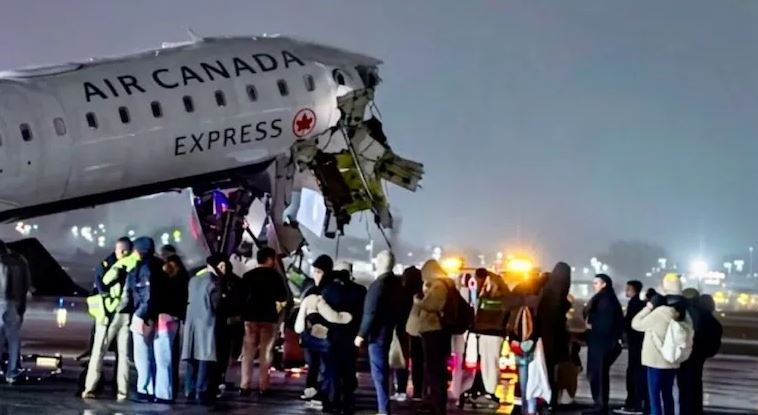
According to early reports, the regional jet identified as a Bombardier CRJ-900 operated by Air Canada Express had just landed after departing from Montreal when the collision took place. The aircraft struck what is believed to be an airport ground vehicle, possibly a fire truck or rescue vehicle, while moving along the runway or taxiway.
Emergency response teams were immediately dispatched to the scene. Firefighters and rescue personnel rushed to assist passengers and crew, as well as individuals inside the ground vehicle. Authorities confirmed that multiple people were injured, with some reported to be in critical condition. While the exact number of casualties remains unclear, initial updates suggested that both airport personnel and passengers were among the injured.
Eyewitness visuals and unverified footage circulating on social media showed the aircraft with significant damage to its nose section, tilted upward after the impact. The force of the collision appeared substantial, indicating the aircraft was still moving at a notable speed during the incident.
The collision prompted immediate action from aviation authorities. The U.S. Federal Aviation Administration (FAA) issued a ground stop at LaGuardia Airport, effectively halting all incoming and outgoing flights. As a result, numerous flights were delayed, diverted, or canceled, causing chaos for travelers and airlines alike.
Passengers at the airport were advised to check with their respective airlines for updates, while local authorities warned of traffic congestion and emergency activity in the surrounding areas. The incident also led to road closures and increased security measures near the airport, as emergency teams continued their operations.
Preliminary information suggests that weather conditions may have played a role in the incident. Reports indicate that rain and reduced visibility were present at the time, potentially complicating runway operations. However, officials have not yet confirmed the exact cause, and a detailed investigation is currently underway.
Air traffic control communications may also come under scrutiny. Early updates hinted that warnings were issued to the ground vehicle before the collision, but it remains unclear whether those instructions were followed or if there was a breakdown in communication. Investigators are expected to analyze cockpit recordings, air traffic control logs, and surveillance footage to determine the sequence of events leading up to the crash.
The aircraft involved in the incident is part of Air Canada Express’s regional fleet, commonly used for short-haul routes between Canadian and U.S. cities. These aircraft are designed for efficiency and frequent operations, making safety protocols on busy runways even more critical.
This incident highlights the risks associated with what is known in aviation as a “ground collision,” where an aircraft comes into contact with another object while on the runway or taxiway. Such accidents, though relatively rare, can have serious consequences due to the complexity of airport operations and the high volume of traffic.
Authorities, including the FAA and local law enforcement agencies, have launched a full-scale investigation into the incident. Air Canada has also stated that it is cooperating with officials and will provide assistance to affected passengers.
As investigations continue, aviation experts emphasize the importance of strict coordination between pilots, air traffic controllers, and ground personnel to prevent such incidents. Enhanced safety measures, improved communication systems, and better training protocols may be necessary to reduce the likelihood of similar accidents in the future.
The situation remains fluid, with more updates expected as officials release verified information. For now, the focus remains on providing medical care to the injured and restoring normal operations at one of New York’s busiest airports.