
Posted on September 25, 2026
With the launch of the ‘Make in India’ program on September 25, 2014, the goal was to build manufacturing capacity, invite investments, generate employment opportunities and make India one of the major manufacturers globally. However, after 12 years, despite some visible effects in certain sectors, the general picture is rather varied. According to the recently collected statistics concerning growth, exports, investments and employment, the developments are noticeable only in a selected number of sectors but not in manufacturing overall.
This brings up a question whether India’s manufacturing economy has undergone any changes since the implementation of the ‘Make in India’ program.
Manufacturing Growth Has Not Been Uniform
One of the most straightforward ways of analyzing the effectiveness of the initiative is comparing manufacturing growth to overall economic growth.
Based on the figures presented in the report, manufacturing growth was faster than overall economic growth in only five out of 12 years calculated based on the old national account series. According to the new national accounts series, manufacturing growth has outperformed overall economic growth in the three years for which relevant figures have been reported; however, the gap between them has been shrinking.
The share of manufacturing in Gross Value Added offers another insight into the issue. According to the latest series of national accounts, the share of manufacturing increased from 14.6% in 2022-23 to 15.6% in 2025-26. Yet, this still leaves much to be desired as the goal was to increase the role of manufacturing in the Indian economy significantly.
In other words, rising industrial output does not necessarily imply structural changes in the economy.
Exports Have Increased, But Global Share Remains a Challenge
Exports of non-petroleum products have increased in India since 2014. From the data presented, exports of non-petroleum products have gone up from about $253.5 billion when the Make in India scheme started in the year to $388.3 billion in 2025-26.
Nevertheless, the growth in export value must be considered in light of the role of India in international trade. According to the statistics provided by UNCTAD, India’s share in international merchandise exports was about 1.7 percent in 2013 and did not change much up to 2025-26.
The difference is significant in that India is exporting more products than before, but its relative share of the growing international merchandise exports has not been significantly altered.
To make India a major manufacturing center, the next step for India may not be just to produce more but also to become competitive and technologically advanced.
Investment Signals Point to an Uneven Response
Another vital sign of manufacturing momentum is private investment.
As per the report, it can be seen that gross fixed capital formation in the private sector accounted for a smaller share of the GDP in 2023-24 as compared to 2014-15. The new series also suggests a fall in this proportion since 2022-23.
Foreign investment in the manufacturing industry has also improved to some extent, but the growth rate has not been greater than the FDI growth rate. The proportion of the manufacturing industry in the total FDI has risen from almost 48 percent in 2014-15 to 55 percent in 2025-26.
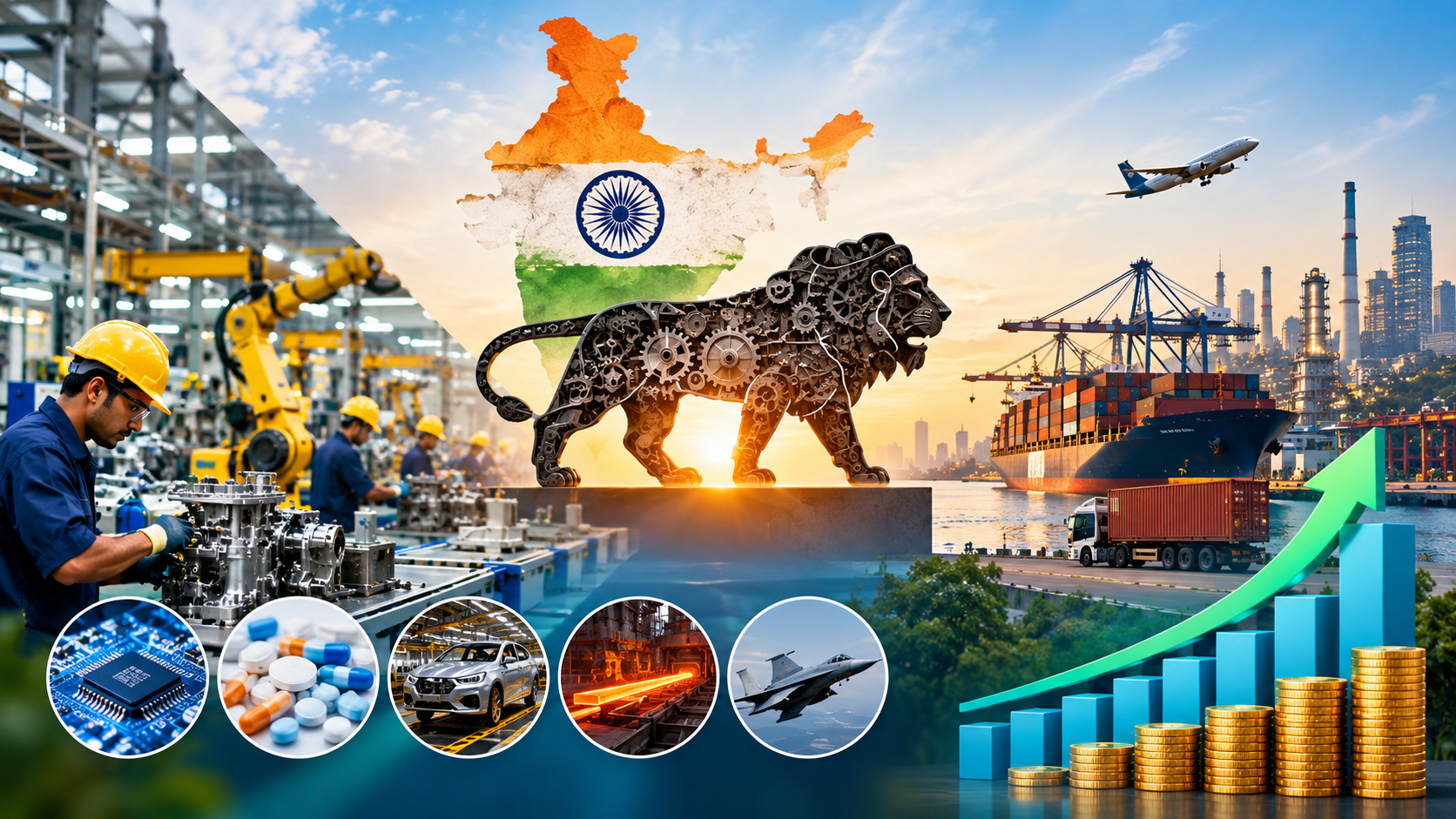
On the other hand, there has been an increase in manufacturing capacity in many industrial sectors of India. As per official figures, there have been large gains in the production of electronics, mobile phones, steel, pharma products, automobiles, and defence manufacturing. In terms of figures, for instance, the electronics manufacturing capacity has risen from roughly ₹1.9 lakh crore in 2014-15 to ₹13.11 lakh crore in 2025-26.
The PLI schemes are some of the most prominent features of India’s recent industrial policies.
They have been rolled out in 14 sectors and led to significant investment, production, and exports. As of March 2026, the total investment under the schemes was said to be ₹2.4 lakh crore.
But the impact of the schemes has been limited to a few sectors only. Solar modules, pharmaceuticals, automobiles, auto-components, specialty steel, and large electronics collectively contributed to nearly 83% of the investment under the schemes.
Such focus on specific sectors shows that there is both promise and a shortcoming associated with sector-specific industrial incentives. While such incentives can boost certain sectors, industrial revolution needs improvement in several areas.
Employment Remains One of the Biggest Tests
Generation of productive employment has been an essential expectation of manufacturing growth in India.
As can be seen from data quoted in the report, there was growth in manufacturing employment from 5.1 crore to 5.3 crore from 2016-17 to 2025-26. Nevertheless, manufacturing’s total employment share did not change significantly from its position a decade ago.
It is true that PLI-backed sectors have contributed to job creation, albeit on a selective basis. Food processing, electronic products, pharmaceuticals, automobiles and automobile parts, and white goods constituted more than 86% of the 8.5 lakh jobs created through these schemes.
The question now is how manufacturing growth in specific sectors can be translated into employment.
Conclusion
“Make in India,” now celebrating its twelve years in operation, has seen some tangible successes in manufacturing through targeted sectors such as electronics, pharmaceuticals, automobiles, steel and defense. However, when one looks at the figures as a whole, one realizes that India’s manufacturing revolution is yet to be fully realized.
What the future holds is no longer going to be about how much India manufactures, but about how much value creation, technology, investment and employment can be generated in India while simultaneously increasing India’s engagement in international manufacturing systems.
Stay abreast of developments in the Indian economy and Indian manufacturing to see what implications these may hold for business and industry.