
Posted on December 5, 2025
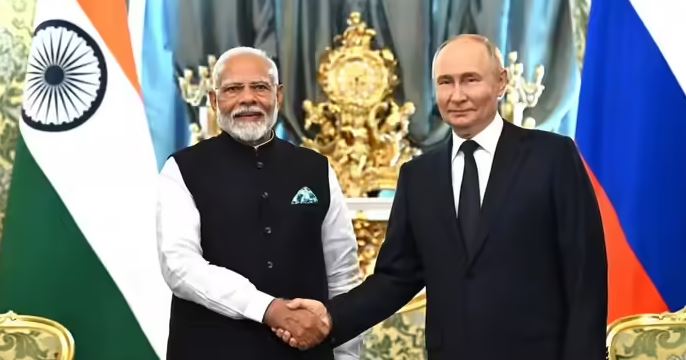
On December 5, 2025, India and Russia strengthened their economic partnership with a historic trade agreement, announced during the 23rd India Russia Annual Summit in New Delhi. Prime Minister Narendra Modi and Russian President Vladimir Putin unveiled a roadmap to expand bilateral trade and investments until 2030.
The ambitious program sets the target of $100 billion in annual bilateral trade by 2030 and $50 billion in mutual investments by 2025, aiming to diversify economic cooperation across multiple sectors.
Key Highlights of the Indo-Russian Trade Agreement
- Diversification Beyond Energy
Historically, India’s imports from Russia have been energy-heavy. This new deal broadens the scope of trade to include:
- Fertilizers and agriculture
- Medical sciences and healthcare
- Consumer protection and food safety
- Shipping, maritime logistics, and port operations
- Industrial and Infrastructure Cooperation
Indian firms will collaborate with Russian companies to establish key industrial projects, including a urea plant in Russia. Port and shipping sector MoUs aim to improve trade logistics and connectivity.
- Energy Security
Russia assured uninterrupted fuel and energy supplies to India, providing a strategic buffer against global energy volatility.
- Investment Opportunities
The program targets joint investments of $50 billion by 2025, focusing on sectors like fertilizers, food processing, infrastructure, and industrial development.
Why This Agreement is Significant
- Balanced Trade: India aims to increase its exports in agriculture, fertilizers, and manufactured goods, reducing trade imbalance.
- Resilient Partnership: Diversifying cooperation into multiple sectors ensures long-term economic and strategic stability.
- Strategic Autonomy: The agreement strengthens both nations’ ability to navigate global geopolitical pressures.
- Infrastructure & Logistics Boost: Maritime and port collaboration could significantly improve trade efficiency and connectivity.
Challenges Ahead
Despite its ambitious scope, the program faces several challenges:
- Scaling Indian exports to match Russia’s demand
- Navigating regulatory and non-tariff barriers in agriculture, medical, and consumer goods
- Implementing MoUs into tangible industrial and infrastructure projects
- Mitigating the impact of global sanctions and geopolitical tensions
The Road Ahead
If successfully implemented, this agreement could reshape India-Russian trade, making it more diversified, balanced, and mutually beneficial. By 2030, both nations aim to establish a resilient economic partnership that goes beyond energy and defense, impacting industries, employment, and regional trade stability.